
- Home
- All Products
- Copper
- Copper Rods, Bars & Flats
Copper Rods, Bars and Busbar Flats in E.C. Grade
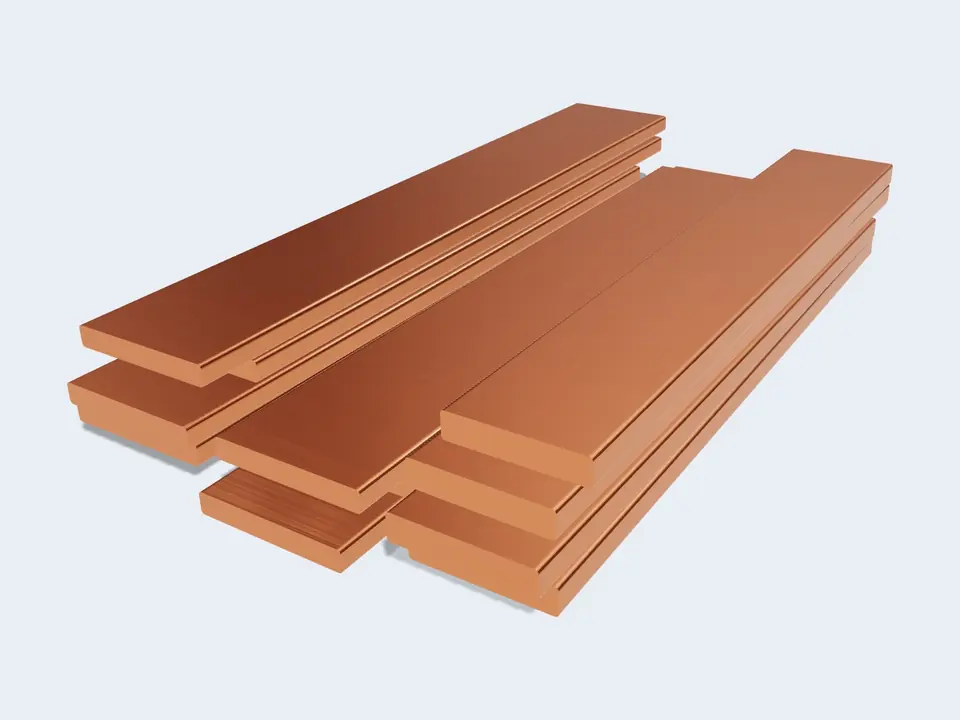
Jubilant Impex supplies copper bus bar in Bangalore as E.C. grade flats, plus round, square and hexagonal copper rods, in hard, half hard or soft condition and bare, tinned or nickel-plated. Busbar is made to IS 613 or ASTM B187 type requirements in Cu-ETP copper. Sizes are confirmed at enquiry, with a test certificate on request.
Most of the copper bar that leaves an S.P. Road counter ends up inside an electrical panel. Panel builders in Peenya, Bommasandra and Electronic City cut it into busbars, droppers and earth bars; switchgear shops machine it into contacts and terminals; electroplaters hang their jobs off it. A smaller share goes into machined parts, earthing spikes and general fabrication.
This page covers the bar forms on our product sheet: copper round bars, square and hexagonal bars, flats and strips, along with a weight chart, since copper bar is bought by the kilogram.
Copper bus bar for panels and switchgear
Busbar flats are rectangular copper sections, normally rolled or drawn from E.C. grade copper so they conduct at or near 100 % IACS. In Indian specifications the usual reference is IS 613, copper rods and bars for electrical purposes; export and EPC jobs often cite ASTM B187, which covers bus bar in soft (O60) and hard (H04) tempers. Our E.C. grade copper page has the chemistry and conductivity details.
For a copper bus bar order in Bangalore, the useful details are width and thickness, length (random or cut), temper, edge type, and whether the bar should be tinned. Rounded or radiused edges are preferred for higher-voltage and high-current work because they reduce local field concentration and make the bar safer to handle.
How is busbar size chosen?
Busbar is sized for current, permitted temperature rise, short-circuit withstand and the space available, not by a single amps-per-square-millimetre figure. Panel designers use the manufacturer's type-tested data or published ampacity tables, adjusted for ambient temperature, enclosure ventilation and how many bars run in parallel per phase. We supply the copper; the rating belongs to your panel design. What we can do is suggest standard flats close to your calculated section so you are not paying for an odd size to be specially rolled.
Round, square and hex copper bar
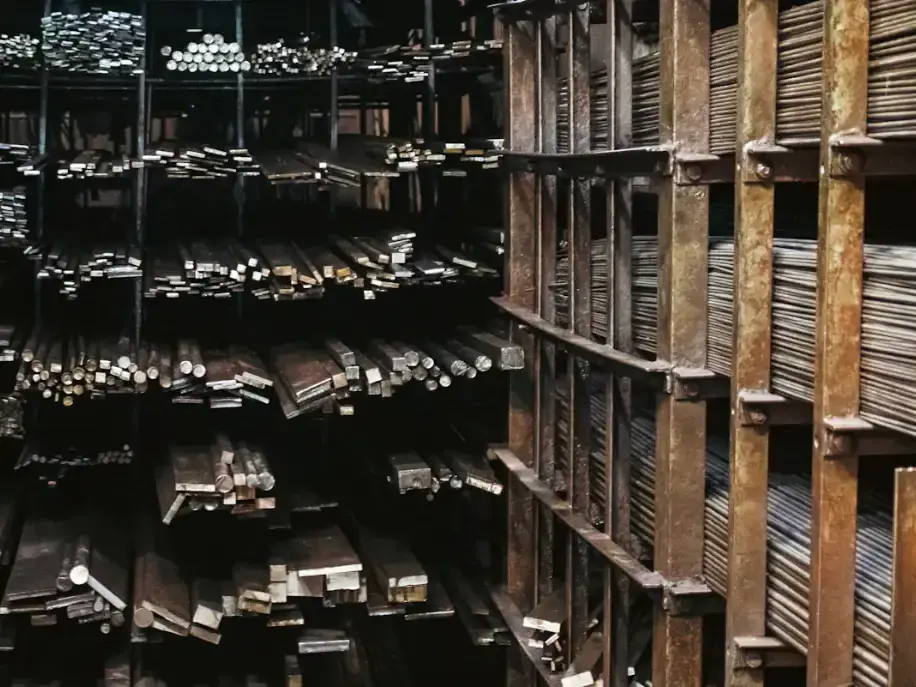
Round copper rod goes into earthing spikes, lightning arrester tips, terminals, studs, welding electrode holders and turned parts. Square bar is used for terminal blocks and commutator-type parts. Hex bar is chosen when the finished part needs spanner flats, such as cable glands, earth terminals and connectors.
A note on machining: pure copper is soft and gummy. It machines, but it tends to build up on the tool edge and leave burrs, so turning shops use sharp, polished tools with generous rake. If the part does not need copper's conductivity, a free-cutting brass from our brass rods range will machine far faster.
View as table
| Metal | Density |
|---|---|
| Aluminium | 2.70 g/cm³ |
| Antimony | 6.68 g/cm³ |
| Zinc | 7.14 g/cm³ |
| Tin | 7.29 g/cm³ |
| Duplex 2205 | 7.80 g/cm³ |
| Carbon & mild steel | 7.85 g/cm³ |
| Stainless 304 | 7.93 g/cm³ |
| Incoloy 825 | 8.14 g/cm³ |
| Inconel 625 | 8.44 g/cm³ |
| Brass 70/30 | 8.53 g/cm³ |
| Gun metal | 8.72 g/cm³ |
| Monel 400 | 8.80 g/cm³ |
| Phosphor bronze | 8.86 g/cm³ |
| Hastelloy C276 | 8.89 g/cm³ |
| Nickel | 8.90 g/cm³ |
| Copper | 8.94 g/cm³ |
| Lead | 11.34 g/cm³ |
What does a copper flat weigh per metre?
Copper weighs about 8.9 kg per square millimetre per kilometre, so the quick formulas are:
- Flat or square: width (mm) × thickness (mm) × 0.0089 = kg per metre
- Round: diameter (mm) × diameter (mm) × 0.00699 = kg per metre
- Hexagon: across flats (mm) × across flats (mm) × 0.0077 = kg per metre
View as table
| Diameter | kg per metre |
|---|---|
| 10 mm dia | 0.70 kg/m |
| 16 mm dia | 1.80 kg/m |
| 20 mm dia | 2.81 kg/m |
| 25 mm dia | 4.39 kg/m |
| 32 mm dia | 7.19 kg/m |
| 40 mm dia | 11.23 kg/m |
| 50 mm dia | 17.55 kg/m |
| 63 mm dia | 27.87 kg/m |
| 80 mm dia | 44.94 kg/m |
| 100 mm dia | 70.21 kg/m |
Temper and finish
Hard (H04) bar stays straight in long runs and resists sag and short-circuit forces. Soft bar bends tightly without cracking and suits droppers and links that are formed at assembly. Half hard sits between the two and is a common choice for busbars bent once in a press brake. If your busbars are bent edgewise, say so: edgewise bending is far more demanding than flatwise and needs softer material and a larger radius.
Tinned copper busbar is worth the extra cost for coastal sites, chemical plants, sewage pumping stations and anywhere sulphur gases are present. Nickel-plated flats suit battery interconnects and hot enclosures.
| Section | kg per metre |
|---|---|
| Flat 25 × 3 mm | 0.67 |
| Flat 25 × 6 mm | 1.34 |
| Flat 40 × 5 mm | 1.78 |
| Flat 50 × 6 mm | 2.67 |
| Flat 50 × 10 mm | 4.45 |
| Flat 100 × 10 mm | 8.90 |
| Round 10 mm | 0.70 |
| Round 25 mm | 4.37 |
| Round 50 mm | 17.48 |
| Square 20 mm | 3.56 |
| Hex 20 mm A/F | 3.08 |
Getting a good bolted joint
A busbar is only as good as its joints. Contact faces should be flat, free of burrs and cleaned just before assembly; a light abrasive pad on bare copper removes the oxide film that builds up in storage. Tinned faces should only be wiped, not abraded, or the tin is lost. Use the bolt size and torque from your panel design, with spring or conical washers so the joint keeps its clamping force as the copper heats and cools. A joint that runs warm on a thermal camera at commissioning nearly always traces back to one of these steps.
Sizes and cutting
Busbar flats are commonly supplied in the trade from about 12 × 3 mm up to 100 × 10 mm and wider, and round bar from a few millimetres to well over 50 mm diameter. Tell us the sizes and quantity you need and we will confirm what is available and the lead time. Cut lengths can be supplied, and the test certificate can carry chemistry, conductivity and mechanical results.
Where Copper Rods, Bars & Flats is used
Questions about Copper Rods, Bars & Flats
Still unsure? Call 080-41159995 or WhatsApp +91 98441 25506 and we will answer from the trade desk.
What is the difference between a copper rod and a copper bar?
In trade use, rod usually means a round section and bar covers square, hexagonal and rectangular sections, including busbar flats. Standards use both words together, as in IS 613 copper rods and bars for electrical purposes. When ordering, describe the shape and dimensions rather than relying on the word rod or bar.
Why are copper busbars tinned?
Tinning protects the copper surface from oxidation and from sulphur and chloride attack, which keeps bolted joints at a stable, low contact resistance over years of service. It also helps at copper-to-aluminium joints. In clean, dry indoor panels, bare copper busbars perform well; tinning matters most in coastal, chemical and sewage plant installations.
Can copper busbar be bent on site?
Yes, if the temper suits it. Soft or half hard busbar bends flatwise on a hand or hydraulic bender with an inside radius of roughly one to two times the thickness. Hard bar needs a larger radius and may crack on tight bends. Edgewise bends need soft copper and proper tooling, and should be tried on an offcut first.
Is EC grade copper required for earth bars?
Most electrical specifications ask for electrolytic copper for earth bars because the earth path must carry fault current with minimal resistance and heating. Commercial copper may conduct well in practice but is not guaranteed. Specifying E.C. grade, ideally with conductivity reported on the test certificate, removes any argument at inspection.
How do I calculate the weight of a copper flat?
Multiply width by thickness in millimetres, then by 0.0089, to get kilograms per metre. A 50 × 6 mm flat is 50 × 6 × 0.0089 = 2.67 kg/m, so a 3.6 m length weighs about 9.6 kg. This is a theoretical figure; rolling tolerance and rounded edges make actual weight slightly different.
Keep exploring
Copper
Jubilant Impex is a copper supplier on S.P. Road, Bangalore, dealing in electrolytic (E.C. grade) and commercial quality copper.
View details →E.C. Grade Copper (Electrolytic)
EC grade copper is electrolytic tough pitch (ETP) copper, designated Cu-ETP, UNS C11000 or CW004A, with at least 99.90 % copper…
View details →
Tinned Copper
Tinned copper is copper wire, strip or busbar coated with a thin layer of tin.
View details →
Hard Drawn Copper
Hard drawn copper is copper that has been cold drawn or rolled to size and not annealed afterwards.
View details →Copper Lightning Arrester & Earthing Material
A copper lightning arrester, in Indian site language, is the copper air terminal or spike fixed at the highest point of a…
View details →
Brass Rods: Round, Hex & Square
Jubilant Impex supplies brass rod in Bangalore in round, hexagonal and square sections, either extruded or commercial quality.
View details →Electrical & Power Distribution
Electrical and power distribution equipment runs on EC grade copper, which is at least 99.9% pure with conductivity close to 100%…
View details →
Electroplating & Surface Finishing
Electroplating materials are the metals a plating line consumes or conducts through: nickel anodes for nickel baths, lead-tin or…
View details →Need copper rods, bars & flats? Get a quote today.
Send the material, grade, size and quantity. We confirm availability and price, with the test certificate details.