
- Home
- All Products
- Copper
- E.C. Grade Copper (Electrolytic)
E.C. Grade Copper: Electrolytic Tough Pitch for Conductors
EC grade copper is electrolytic tough pitch (ETP) copper, designated Cu-ETP, UNS C11000 or CW004A, with at least 99.90 % copper including silver and an annealed conductivity of 100 % IACS (58 MS/m). It is the standard material for busbars, earthing conductors and bare wire. Jubilant Impex supplies it in Bangalore with test certificates.
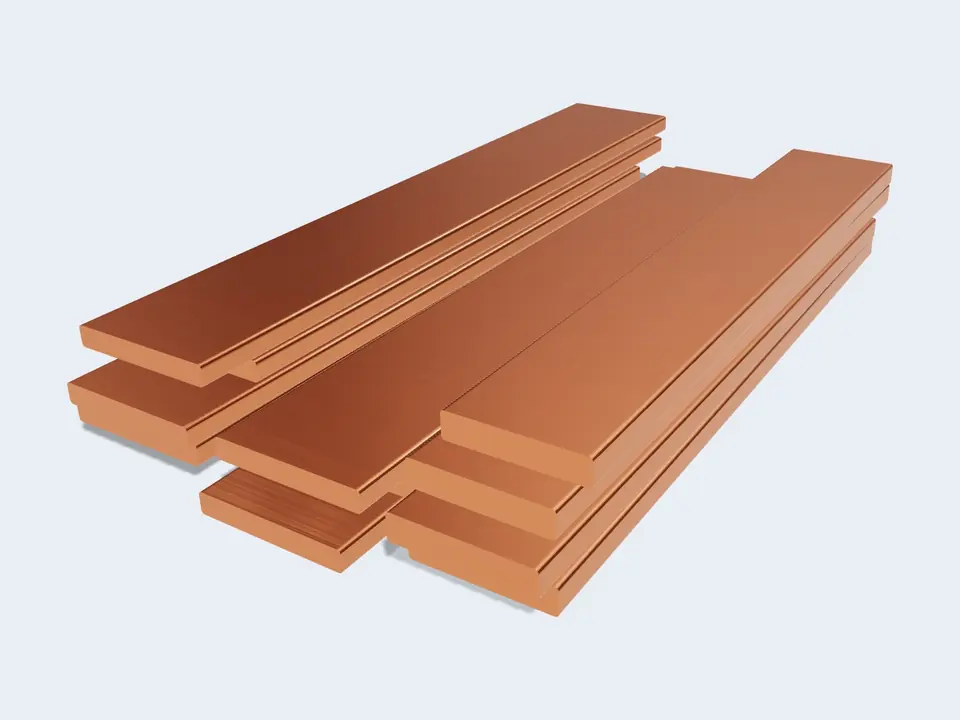
E.C. Grade Copper (Electrolytic) specifications
Per EN 13601 (Cu-ETP, CW004A), weight %
| Cu (incl. Ag) | 99.90 min |
|---|---|
| Bi | 0.0005 max |
| O | 0.040 max |
| Pb | 0.005 max |
| Other elements (excl. Ag, O) | 0.03 max total |
ASTM B187 (C11000 rod and bar)
| Tensile strength, O60 soft, all sizes | 28–37 ksi |
|---|---|
| Elongation, O60 soft | 25 % min |
| Tensile strength, H04 hard rod over 3/8 to 1 in | 40–55 ksi |
| Elongation, H04 hard rod over 3/8 to 1 in | 12 % min |
| Bend test (when ordered) | 180° O60, 120° H04 |
Typical values
| Density | 8.89–8.94 g/cm³ |
|---|---|
| Melting point | 1083 °C |
| Electrical resistivity, annealed, 20 °C | 0.017241 Ω·mm²/m max (100 % IACS) |
| Conductivity, annealed | 58.0 MS/m min |
| Thermal conductivity | About 390 W/m·K |
| Coefficient of thermal expansion (20–100 °C) | About 17 × 10⁻⁶ /K |
| Modulus of elasticity | About 117 GPa |
Designations in other standards
| UNS | C11000 |
|---|---|
| EN | Cu-ETP, CW004A |
| IS | Cu-ETP (IS 191) |
| DIN (old) | E-Cu58, 2.0065 |
| BS (old) | C101 |
| JIS | C1100 |
| ISO | Cu-ETP |
Available forms
Enquire about E.C. Grade Copper (Electrolytic)
Tell us grade, size, quantity and delivery location. Every consignment ships with a test certificate.
Request a quoteWhatsApp +91 98441 25506Or call 080-41159995
How E.C. Grade Copper (Electrolytic) measures up
- Cu 0.1%
- Cu 0.1%
View as table
| Element | Nominal % |
|---|---|
| Cu | 0.1% |
| Cu | 100% |
View as table
| Material | Conductivity |
|---|---|
| Copper E.C. (Cu-ETP) | 100% IACS |
| Aluminium (EC grade 1350) | 61% IACS |
| Aluminium 6063 | 53% IACS |
| Brass 70/30 | 28% IACS |
| Phosphor bronze | 15% IACS |
| Carbon steel | 10% IACS |
| Stainless 304 | 2.5% IACS |
E.C. stands for electrical conductor, and in the Indian trade it has become shorthand for one specific material: electrolytic tough pitch copper. When a panel drawing or an earthing BOQ says 'E.C. grade', the engineer is asking for copper that has been refined electrolytically, cast with a controlled trace of oxygen, and tested to conduct at least as well as the international annealed copper standard.
Most of the confusion we sort out on the phone comes from mixed naming. ETP, C11000, CW004A, E-Cu58, C101 and 'electrolytic copper' are all describing the same thing, written to different national standards. The table further down lines them up.
What is EC grade copper, exactly?
Copper cathode from the refinery is melted and cast into wire bar, cake or continuous-cast rod. In tough pitch copper the oxygen is deliberately left at a few hundredths of a percent. That oxygen combines with impurities such as iron, tin and sulphur and pulls them out of solution as tiny oxide particles. Impurities in solution are what spoil conductivity, so locking them up as oxides is why ETP reaches 100 % IACS without being as costly to make as oxygen-free copper.
The result is a metal with a minimum of 99.90 % copper (silver counted as copper), roughly 0.02–0.04 % oxygen, and very tight limits on bismuth and lead, both of which make copper brittle during hot working.
Which standards cover E.C. grade copper?
Different standards cover different stages and shapes, and a purchase order should name the product standard rather than just the grade.
- IS 191: the Indian specification for copper in refinery shapes, which defines the Cu-ETP grade alongside Cu-DHP, Cu-FRHC and others
- IS 613: copper rods and bars for electrical purposes, the usual reference for busbars in Indian panel and switchgear specifications
- IS 1897: copper strip for electrical purposes
- ASTM B187: copper bus bar, rod and shapes, with soft (O60) and hard (H04) tempers
- ASTM B152: copper sheet, strip, plate and rolled bar, which lists C11000 among its coppers
- EN 13601: copper rod, bar and wire for general electrical purposes, where the grade is Cu-ETP, CW004A
| Property | Cu-ETP (C11000) | Cu-OF (C10200) | Cu-DHP (C12200) |
|---|---|---|---|
| Cu (incl. Ag) | 99.90 % min | 99.95 % min | 99.9 % min |
| Oxygen | Up to 0.040 % | 0.0010 % max | Deoxidised |
| Phosphorus | Not added | Not added | 0.015–0.040 % |
| Annealed conductivity | 100 % IACS min | 100 % IACS min | About 85 % IACS |
| Hydrogen embrittlement | Susceptible | Not susceptible | Not susceptible |
| Typical use | Busbar, earthing, wire | Vacuum and electronic parts | Tubes, brazed parts |
100 % IACS, in plain numbers
IACS is the International Annealed Copper Standard, set in 1913. It fixes the resistivity of a reference annealed copper at 0.15328 Ω·g/m² by mass, equal to 0.017241 Ω·mm²/m by volume at 20 °C. That reference is called 100 % IACS, or 58.0 MS/m. Annealed Cu-ETP has to meet it; good modern material usually tests a point or so above, around 101 %, because refining has improved since 1913.
Cold work costs a few percent. Hard drawn wire to ASTM B1 is allowed down to about 97 % IACS for heavy sizes. If your busbar specification calls for a conductivity figure, check which temper it applies to before comparing certificates. For the trade-off in detail, see our pages on hard drawn copper and soft annealed copper.
The weak spot: heating ETP in hydrogen
The same oxygen that helps conductivity is ETP copper's one real limitation. Heat it above roughly 400 °C in an atmosphere containing hydrogen, such as a reducing furnace or an oxy-acetylene flame, and hydrogen diffuses in, reacts with the copper oxide particles and forms steam. Steam cannot diffuse out, so it builds pressure at the grain boundaries and the copper cracks or blisters. Engineers call this hydrogen embrittlement.
In practice this means ETP is fine for bolted busbar joints, soldered lugs, crimped terminals and exothermic earthing joints made quickly, but tube work and furnace-brazed assemblies are made from deoxidised copper instead. That is why our copper pipes and tubes are DHP grade, not E.C.
ETP copper vs oxygen-free copper
Oxygen-free copper (Cu-OF, C10200) is cast under a protective atmosphere so oxygen stays below about 0.001 %. It is immune to hydrogen embrittlement and is used for vacuum devices, high-end electronics and parts that are hydrogen brazed. For busbars, earthing and general conductors, ETP gives the same 100 % IACS at a lower price, which is why it dominates Indian electrical work.
Forms in E.C. grade
We handle E.C. grade copper as round, square and hexagonal bars, busbar flats, strips, sheets, plates and wire, in hard or soft condition and bare, tinned or nickel-plated. Sizes are confirmed at enquiry. Busbar sizes and weights per metre are on the rods, bars and flats page.
Two things are worth settling before you order. First, the temper: soft for anything bent or formed on site, hard or half hard for straight runs that must stay rigid. Second, the paperwork: if your customer is a utility, a PSU or an EPC contractor, ask for the test certificate to report conductivity as well as chemistry, because that is the figure their inspector will check first.
Where E.C. Grade Copper (Electrolytic) is used
Questions about E.C. Grade Copper (Electrolytic)
Still unsure? Call 080-41159995 or WhatsApp +91 98441 25506 and we will answer from the trade desk.
What does ETP stand for in copper?
ETP means electrolytic tough pitch. Electrolytic refers to the refining route, where copper is purified to cathode in an electrolytic cell. Tough pitch describes the controlled oxygen content left in the cast metal, typically 0.02–0.04 %, which ties up impurities as oxides so they do not reduce conductivity. In India this material is sold as E.C. grade copper.
Is EC grade copper the same as C11000?
For practical purposes, yes. C11000 is the UNS number for electrolytic tough pitch copper, Cu-ETP is the ISO and IS 191 name, and CW004A is the European number. All require at least 99.90 % copper including silver and 100 % IACS in the annealed condition. The product standard, such as IS 613 or ASTM B187, then sets tempers and tolerances.
What is the conductivity of EC grade copper?
Annealed E.C. grade copper must reach 100 % IACS, which is 58.0 MS/m or a resistivity of 0.017241 Ω·mm²/m at 20 °C. Most material tests slightly above that, around 101 %. Hard drawn E.C. copper is lower because cold work adds resistance; ASTM B1 permits about 96–97 % IACS depending on wire size.
Can EC grade copper be brazed or welded?
It can be soldered and bolted without problems, and brazed or welded with care. The risk is hydrogen embrittlement: heated above about 400 °C in a hydrogen-bearing flame or furnace, its oxide particles react to form steam and the metal can crack. For brazed or welded assemblies, phosphorus-deoxidised or oxygen-free copper is the safer choice.
How is EC grade copper checked on a test certificate?
Look for copper content (Cu plus Ag, 99.90 % minimum), oxygen, and the main impurities like bismuth and lead, plus electrical conductivity in % IACS or resistivity at 20 °C. For busbars, tensile strength, elongation or a bend test may also be reported. The certificate should name the standard and carry a heat or lot number.
Why is it called tough pitch?
The term comes from old refining practice. Molten copper was poled to bring oxygen down to the right level, and the furnace operator judged it by the 'set' or pitch of a test sample as it solidified. At the correct oxygen level the surface set level and the copper was tough rather than brittle. The name stuck to the grade.
Keep exploring
Copper
Jubilant Impex is a copper supplier on S.P. Road, Bangalore, dealing in electrolytic (E.C. grade) and commercial quality copper.
View details →Copper Rods, Bars & Flats
Jubilant Impex supplies copper bus bar in Bangalore as E.C. grade flats, plus round, square and hexagonal copper rods, in hard,…
View details →
Hard Drawn Copper
Hard drawn copper is copper that has been cold drawn or rolled to size and not annealed afterwards.
View details →Soft Annealed Copper
Annealed copper is copper that has been heated after cold working so its grains recrystallise, making it soft, ductile and fully…
View details →
Copper Wire
Jubilant Impex supplies copper wire in Bangalore in E.C. grade, as bare round wire in hard drawn or soft annealed temper, and in…
View details →Electrical & Power Distribution
Electrical and power distribution equipment runs on EC grade copper, which is at least 99.9% pure with conductivity close to 100%…
View details →
How to Read a Mill Test Certificate
To read a mill test certificate, first match the heat number on the certificate to the marking on the material.
View details →Need E.C. Grade Copper (Electrolytic) with a test certificate?
Send the material, grade, size and quantity. We confirm availability and price, with the test certificate details.