
- Home
- All Products
- Copper
- Copper Pipes & Tubes
Copper Pipes and Tubes in Straight Lengths and Coils
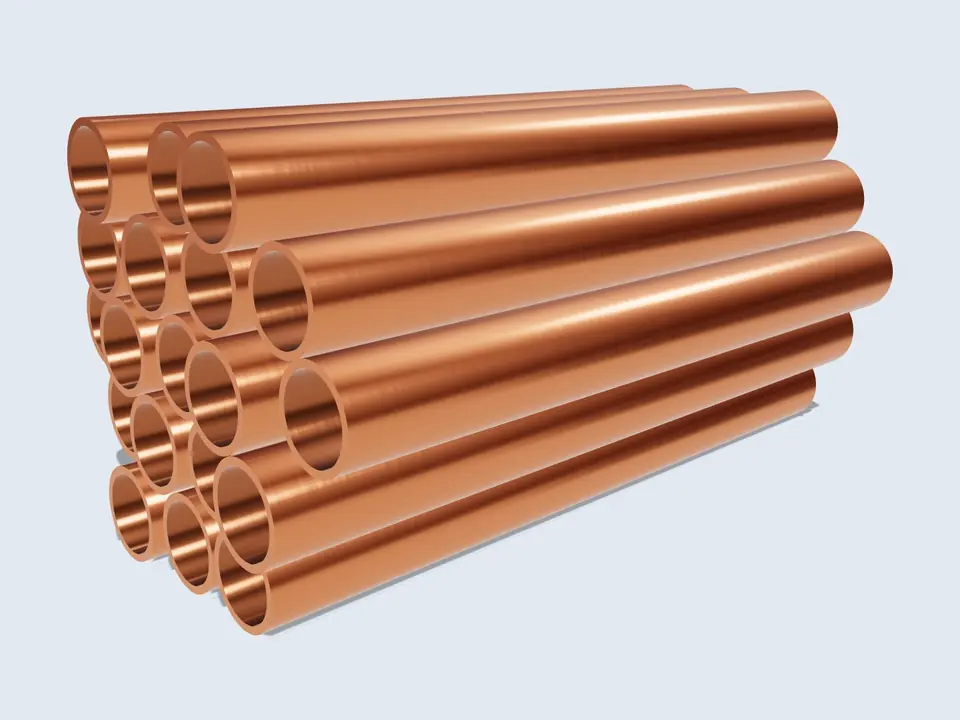
Copper pipes and tubes are made from phosphorus-deoxidised (DHP) copper, C12200, which brazes without embrittling. Jubilant Impex supplies copper pipe in Bangalore as hard drawn straight lengths and soft annealed coils, Indian-made and imported, for AC and refrigeration (ASTM B280), plumbing (ASTM B88 Types K, L, M) and general engineering (IS 2501).
Copper tube is the one copper product where E.C. grade is the wrong answer. Every joint in an AC line set, a hospital gas manifold or a plumbing riser is brazed or soldered with heat, and the oxygen in electrolytic copper would turn that heat into cracks. So tube is made from DHP copper, deoxidised with a trace of phosphorus.
We handle copper pipe and tube in straight lengths and in coils, both indigenous and imported. Here is how to tell the types apart and what to put in your enquiry.
Why tubes are DHP, not ETP
DHP copper carries 0.015–0.040 % phosphorus, which removes the oxygen during casting. With no copper oxide inside, there is nothing for hydrogen to react with when a brazing flame heats the joint, so the tube cannot suffer the steam cracking that affects ETP copper. The cost is conductivity, around 85 % IACS instead of 100 %, which does not matter for a tube carrying refrigerant or water. Our E.C. grade copper page explains the hydrogen problem in more detail.
DHP also flares, swages and expands well, and its slightly higher recrystallisation temperature helps tube keep its drawn temper during handling.
Straight lengths or coils?
Straight lengths are supplied drawn (hard). They stay straight on the rack and in exposed runs, take less support, and suit plumbing risers, medical gas manifolds and visible pipework. Joints are made with fittings and brazing.
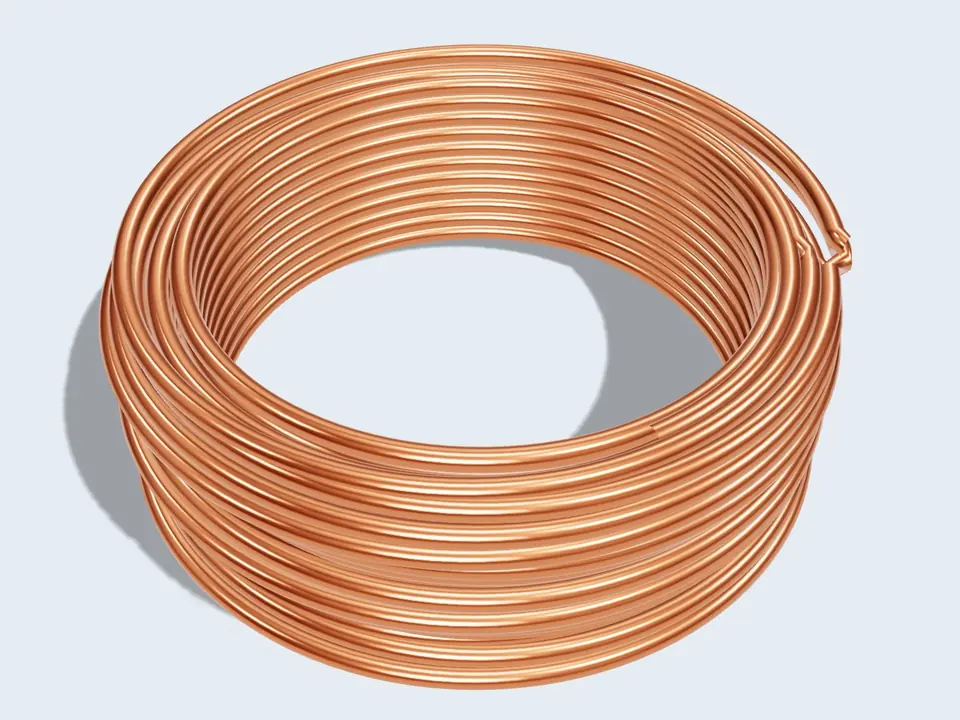
Coils are annealed (soft). An installer can bend them by hand or with a lever bender, flare the ends and run long lengths with very few joints. Split AC line sets and refrigeration connections are almost always run from soft coils. Coil tube is also the usual choice where a single length has to snake through walls and false ceilings.
Medical gas lines are a special case. Hospitals generally ask for hard tube that has been degreased and capped for oxygen service, made to EN 13348 or an equivalent specification, and joined by brazing under a nitrogen purge. If your job is a hospital pipeline, say so at enquiry, because ordinary plumbing tube is not cleaned to that level.
What is ACR copper tube?
ACR stands for air conditioning and refrigeration. ACR tube to ASTM B280 is sized by actual outside diameter in inches (1/4", 3/8", 1/2", 5/8", 3/4" and so on, matching flare nuts and fittings), cleaned inside to a low residue limit, and capped at the ends so moisture and dirt stay out until installation. Dirt and moisture are the enemies of a refrigeration circuit, so keep the caps on until the moment of brazing. In Europe the equivalent is EN 12735-1.
Wall thickness matters more now than it used to. Newer refrigerants such as R-410A and R-32 run at higher pressures than R-22, so check the wall your AC manufacturer specifies rather than buying the thinnest tube on offer.
- Cu 0.1%
- Cu 0.1%
- P 0.0%
View as table
| Element | Nominal % |
|---|---|
| Cu | 0.1% |
| Cu | 100% |
| P | 0.0% |
What is the difference between Type K, L and M copper pipe?
These are wall-thickness classes in ASTM B88, the American standard for water tube. All three share the same outside diameter for a given nominal size, so they take the same fittings; only the wall changes. Type K is thickest and is used underground and for higher pressures; Type L is the general-purpose wall for interior plumbing, heating and many medical and gas installations; Type M is thinnest and used for low-pressure domestic lines where codes allow. Tubes are marked along the length with a colour code: green for K, blue for L, red for M. European plumbing tube follows EN 1057 instead.
View as table
| OD × wall | grams per metre |
|---|---|
| 6.35 × 0.8 mm | 125 g/m |
| 9.52 × 0.8 mm | 196 g/m |
| 12.7 × 0.9 mm | 298 g/m |
| 15.88 × 1 mm | 418 g/m |
| 19.05 × 1 mm | 507 g/m |
| 25.4 × 1.2 mm | 816 g/m |
| 31.75 × 1.2 mm | 1030 g/m |
| 38.1 × 1.5 mm | 1542 g/m |
Indian and imported tube
Indian-made tube is commonly supplied to IS 2501 for general engineering or to customer drawings, and imported tube usually to ASTM or EN standards. Both are DHP copper. What matters is that the standard on the certificate matches the standard on your drawing, particularly for wall thickness and temper. If a project specification names a standard, quote it in the enquiry and we will offer tube that matches.
Coil tube is normally sold by coil, with a nominal length such as 15 m or by coil weight, and straight tube by length or kilogram. Ask for both figures on the quotation so offers can be compared fairly.
Per ASTM B88 / ASTM B280 (C12200), weight %
| Cu (incl. Ag) | 99.9 min |
|---|---|
| P | 0.015–0.040 |
Designations in other standards
| UNS | C12200 |
|---|---|
| EN | Cu-DHP, CW024A |
| IS | Cu-DHP (IS 191) |
| DIN (old) | SF-Cu, 2.0090 |
| BS (old) | C106 |
| JIS | C1220 |
What to tell us
For a quick quote on copper pipe in Bangalore, send outside diameter (inch or mm), wall thickness or type, straight or coil, length or coil weight, quantity, and the standard. We confirm what is available in your size when we quote. For larger heat exchanger work, see also our brass pipes and tubes, and for HVAC projects, our refrigeration and HVAC page.
| Nominal size (OD) | Type K | Type L | Type M |
|---|---|---|---|
| 1/2" (0.625" OD) | 0.049" | 0.040" | 0.028" |
| 3/4" (0.875" OD) | 0.065" | 0.045" | 0.032" |
| Colour marking | Green | Blue | Red |
| Typical use | Underground, high pressure | General plumbing, heating, gas | Low-pressure domestic |
Where Copper Pipes & Tubes is used
Questions about Copper Pipes & Tubes
Still unsure? Call 080-41159995 or WhatsApp +91 98441 25506 and we will answer from the trade desk.
Is copper pipe hard or soft?
Both are made. Straight lengths are normally supplied hard drawn so they stay straight and need fewer supports. Coils are supplied soft annealed so they can be bent and flared by hand. ASTM B88 offers drawn temper for Types K, L and M, and annealed coils for K and L; ACR tube to B280 also comes in both.
Why is copper used for AC piping?
Copper conducts heat well, resists corrosion from refrigerants and oils, and joins reliably by brazing or flaring. Soft coils bend round corners without kinking, reducing joints and leak points. It also handles the high working pressures of modern refrigerants like R-410A and R-32 when the correct wall thickness is used.
What is the difference between copper pipe and copper tube?
Tube is usually sized by actual outside diameter and wall thickness, as with ACR tube. Pipe traditionally refers to nominal sizes linked to a standard schedule or type, as in plumbing. In everyday Indian trade the two words are used interchangeably, so state outside diameter and wall thickness to avoid confusion.
Can copper tube be brazed without problems?
Yes, because tube is made from phosphorus-deoxidised copper that is not prone to hydrogen embrittlement. Copper-to-copper joints are commonly brazed with copper-phosphorus filler, which needs no flux on copper. Flowing dry nitrogen through the tube while brazing prevents internal oxide scale, which matters in refrigeration systems.
Which copper tube grade is used for plumbing?
Plumbing tube is DHP copper, C12200 or Cu-DHP. Thickness is set by the standard the project follows: ASTM B88 Types K, L and M for American-style specifications, EN 1057 for European ones, and Indian standards for local projects. The grade is the same; the wall and the marking differ.
Why must ACR tube be capped?
Moisture, dust and metal particles inside a refrigeration circuit cause acid formation, blocked expansion devices and compressor failures. ACR tube is cleaned and capped at the mill to keep the inside dry and clean. Keeping caps on during storage and transport, and cutting with a tube cutter rather than a hacksaw, protects that cleanliness.
Keep exploring
Copper
Jubilant Impex is a copper supplier on S.P. Road, Bangalore, dealing in electrolytic (E.C. grade) and commercial quality copper.
View details →Soft Annealed Copper
Annealed copper is copper that has been heated after cold working so its grains recrystallise, making it soft, ductile and fully…
View details →
E.C. Grade Copper (Electrolytic)
EC grade copper is electrolytic tough pitch (ETP) copper, designated Cu-ETP, UNS C11000 or CW004A, with at least 99.90 % copper…
View details →
Brass Pipes, Tubes & Capillary
Jubilant Impex supplies brass pipe and tube in Bangalore, drawn in 70/30, 63/37 and 60/40 brass, along with small-bore brass…
View details →Refrigeration & HVAC
Refrigeration and HVAC systems rely on copper tubes for refrigerant lines and coils: soft annealed coils for field runs and…
View details →
Construction & Infrastructure
Construction projects use mild steel angles, channels, beams and plates to IS 2062 for structures, chequered plate for floors and…
View details →
Request a Quote
To request a quote for stainless steel pipes or any metal from Jubilant Impex in Bangalore, send the material, grade, standard,…
View details →Need copper pipes & tubes? Get a quote today.
Send the material, grade, size and quantity. We confirm availability and price, with the test certificate details.