
- Home
- All Products
- Copper
- Tinned Copper
Tinned Copper: When Bare Copper Needs a Coat
Tinned copper is copper wire, strip or busbar coated with a thin layer of tin. The tin protects the copper from moisture, salt air and sulphur compounds and makes it easy to solder, at a small cost in conductivity. Jubilant Impex in Bangalore supplies it on soft or hard E.C. grade base metal, with test certificates.
How Tinned Copper measures up
View as table
| Material | Conductivity |
|---|---|
| Copper E.C. (Cu-ETP) | 100% IACS |
| Aluminium (EC grade 1350) | 61% IACS |
| Aluminium 6063 | 53% IACS |
| Brass 70/30 | 28% IACS |
| Phosphor bronze | 15% IACS |
| Carbon steel | 10% IACS |
| Stainless 304 | 2.5% IACS |
View as table
| Metal | Density |
|---|---|
| Aluminium | 2.70 g/cm³ |
| Antimony | 6.68 g/cm³ |
| Zinc | 7.14 g/cm³ |
| Tin | 7.29 g/cm³ |
| Duplex 2205 | 7.80 g/cm³ |
| Carbon & mild steel | 7.85 g/cm³ |
| Stainless 304 | 7.93 g/cm³ |
| Incoloy 825 | 8.14 g/cm³ |
| Inconel 625 | 8.44 g/cm³ |
| Brass 70/30 | 8.53 g/cm³ |
| Gun metal | 8.72 g/cm³ |
| Monel 400 | 8.80 g/cm³ |
| Phosphor bronze | 8.86 g/cm³ |
| Hastelloy C276 | 8.89 g/cm³ |
| Nickel | 8.90 g/cm³ |
| Copper | 8.94 g/cm³ |
| Lead | 11.34 g/cm³ |
Leave a length of bare copper in a coastal substation, a sewage pumping station or a rubber factory and within months it goes brown, then black or green. The copper is still there underneath, but the surface film raises contact resistance and makes soldering a struggle. A few microns of tin stop most of that.
Tinning is not new. It began in the days of rubber-insulated cable, when the sulphur used to vulcanise the rubber attacked bare copper conductors. Today the reasons are broader, but the idea is the same: a sacrificial, solderable skin over a conductor that is otherwise ideal.
Why is copper tinned?
- Corrosion: tin resists moisture, chlorides from sea air and sulphur gases such as H₂S far better than bare copper does
- Solderability: tin is already solder-compatible, so tinned wire takes solder quickly with mild flux, even after storage
- Stable contact resistance: bolted tinned busbar joints keep a cleaner contact face over time than bare joints in polluted air
- Compatibility with aluminium: a tinned face reduces galvanic attack at copper-to-aluminium connections
- Insulation chemistry: tin acts as a barrier between copper and rubber or some PVC compounds that react with it
What the coating actually is
On tinned wire made to ASTM B33, the coating is two layers: a thin copper-tin intermetallic layer bonded to the copper, and an outer layer of essentially pure tin. The intermetallic layer is what makes the coating adhere; the free tin on top is what gives solderability. Wire is tinned by hot dipping or electroplating, either at finished size or at an intermediate size before the final draw and anneal.
Busbars and flats are normally electro-tinned after cutting and punching, so that the holes and edges are covered too. If your busbars will be drilled after tinning, the bare holes will need attention at assembly.
| Property | Bare copper | Tinned copper | Nickel plated copper |
|---|---|---|---|
| Corrosion in damp or sulphur-bearing air | Tarnishes, blackens or greens | Good resistance | Good resistance |
| Solderability | Good when clean, poor once tarnished | Very good, mild flux | Needs active flux |
| Typical upper service temperature | Oxidises readily when hot | About 150 °C | About 260 °C |
| Wire standard | ASTM B3 (soft), ASTM B1 (hard) | ASTM B33 | ASTM B355 |
| Relative cost | Lowest | Moderate | Higher |
How tinned wire is tested
ASTM B33 does not rely on chemical analysis of the tin. Instead it checks two things. Continuity: cleaned samples are dipped alternately in hydrochloric acid and sodium polysulphide solution, and any spot where copper is exposed turns black. Adherence: the wire is wrapped round a mandrel no larger than four times its diameter, then dipped in polysulphide; if the coating has cracked, the copper beneath blackens.
Like soft bare wire, tinned wire is accepted on elongation and resistivity, not on tensile strength.
Does tinning reduce conductivity?
A little, and more on fine wire than heavy wire. Tin has only about 15 % of copper's conductivity, and in fine wire the coating makes up a larger share of the cross-section. ASTM B33 allows a maximum resistivity of about 0.15695 Ω·g/m² for the largest sizes, roughly 97.7 % IACS, rising to about 0.16454 Ω·g/m² (around 93 % IACS) for the finest. On busbar, where the tin is a few microns on a section several millimetres thick, the effect on DC resistance is negligible.
Ask for the resistivity figure on the certificate if your design depends on it, and quote the wire size, since the permitted limit changes with diameter.
Where tinned copper earns its price
The extra cost is worth it wherever air or soil is aggressive or where joints must be soldered reliably. Typical buyers include panel builders supplying coastal and chemical plants, marine and shipyard electrical contractors, sewage and effluent treatment plant projects, battery and UPS installers, and lightning protection contractors using tinned tape on roofs near the sea. Around Bangalore, where the air is mild, bare copper is usually fine indoors; the question is where the panel will finally be installed.
Tin whiskers are worth a mention for electronics buyers. Pure electroplated tin can, over months or years, grow fine conductive filaments from its surface, which matters on closely spaced circuit parts but not on busbars or earthing conductors. Hot-dipped coatings and reflowed tin are much less prone to it. If your parts go into electronics, tell us so the coating route can be discussed before the order is placed.
The temperature limit
Tin melts at 232 °C and softens well before that, and the tin-copper intermetallic keeps growing at high temperature, eating into the free tin that makes the surface solderable. Tinned conductors are therefore generally used up to about 150 °C. For hotter service, such as furnace wiring or high-temperature PTFE wire, nickel plated copper is the usual alternative.
We can supply tinned copper as round wire, strips and busbar flats, on soft annealed or hard base metal of E.C. grade. Sizes and coating requirements are confirmed at enquiry.
Where Tinned Copper is used
Questions about Tinned Copper
Still unsure? Call 080-41159995 or WhatsApp +91 98441 25506 and we will answer from the trade desk.
Is tinned copper better than bare copper?
It is better in corrosive or humid environments and wherever joints are soldered, because the tin layer protects the copper and stays solderable. It is not better electrically: conductivity is slightly lower, especially in fine wire, and it costs more. For dry indoor installations with bolted or crimped joints, bare copper is usually sufficient.
Does tinned copper wire turn green?
Not while the tin coating is intact. Green patina (verdigris) and black sulphide form on exposed copper, and the tin layer keeps air and moisture away from it. Over many years, or where the coating is scratched or cut, copper underneath can still corrode, which is why cut ends in harsh environments are often sealed.
Can you solder tinned copper wire?
Yes, and more easily than bare copper. The surface is already tin, so solder wets it quickly with a mild rosin flux and little heat. Very old stock can be slower to solder, because the tin-copper intermetallic layer grows over time and the surface oxidises, but a fresh cut and a little flux usually solves that.
Is tinned copper good for marine and coastal use?
Yes, that is one of its main uses. Salt-laden air attacks bare copper and raises contact resistance at joints. Tinned conductors and busbars hold up much better, which is why marine cable makers and coastal panel builders commonly specify them. Sealing cut ends and termination points adds further protection.
What temperature can tinned copper handle?
Tinned copper conductors are generally used up to about 150 °C. Tin melts at 232 °C, and long exposure to high temperature thickens the brittle tin-copper intermetallic layer, consuming the free tin. For higher operating temperatures, nickel plated copper is preferred, typically up to around 260 °C.
Keep exploring
Copper
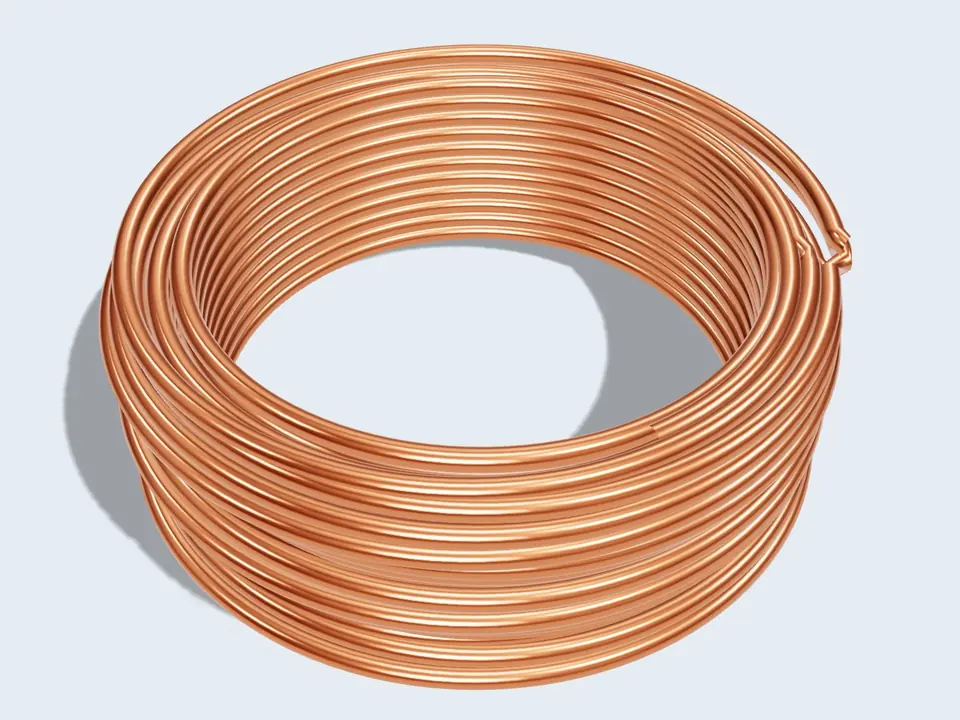
Jubilant Impex is a copper supplier on S.P. Road, Bangalore, dealing in electrolytic (E.C. grade) and commercial quality copper.
View details →
Nickel Plated Copper
Nickel plated copper is copper wire, strip or busbar with an electroplated or clad nickel layer.
View details →
Copper Wire
Jubilant Impex supplies copper wire in Bangalore in E.C. grade, as bare round wire in hard drawn or soft annealed temper, and in…
View details →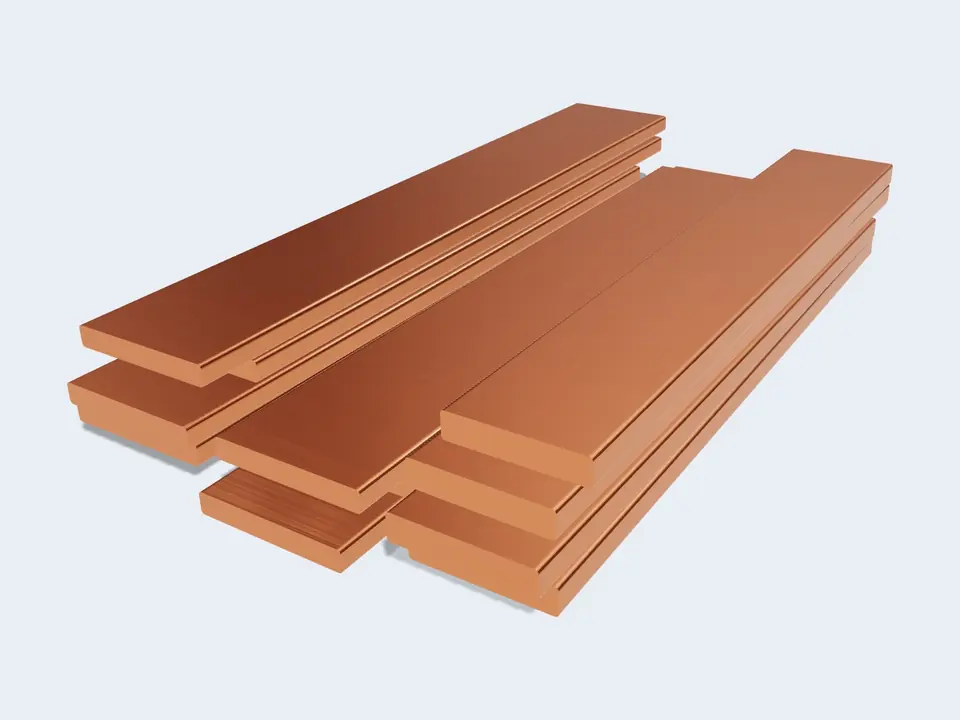
Copper Rods, Bars & Flats
Jubilant Impex supplies copper bus bar in Bangalore as E.C. grade flats, plus round, square and hexagonal copper rods, in hard,…
View details →
Tin Ingots
Tin ingots are cast bars of refined tin, graded by minimum purity.
View details →
Marine & Offshore
Marine grade metals are alloys that resist seawater corrosion: 316L stainless for deck hardware and fittings, duplex for seawater…
View details →Electrical & Power Distribution
Electrical and power distribution equipment runs on EC grade copper, which is at least 99.9% pure with conductivity close to 100%…
View details →Need Tinned Copper with a test certificate?
Send the material, grade, size and quantity. We confirm availability and price, with the test certificate details.