- Home
- All Products
- Ingots
- Lead Ingots
Lead Ingots to IS 27 Purity Grades
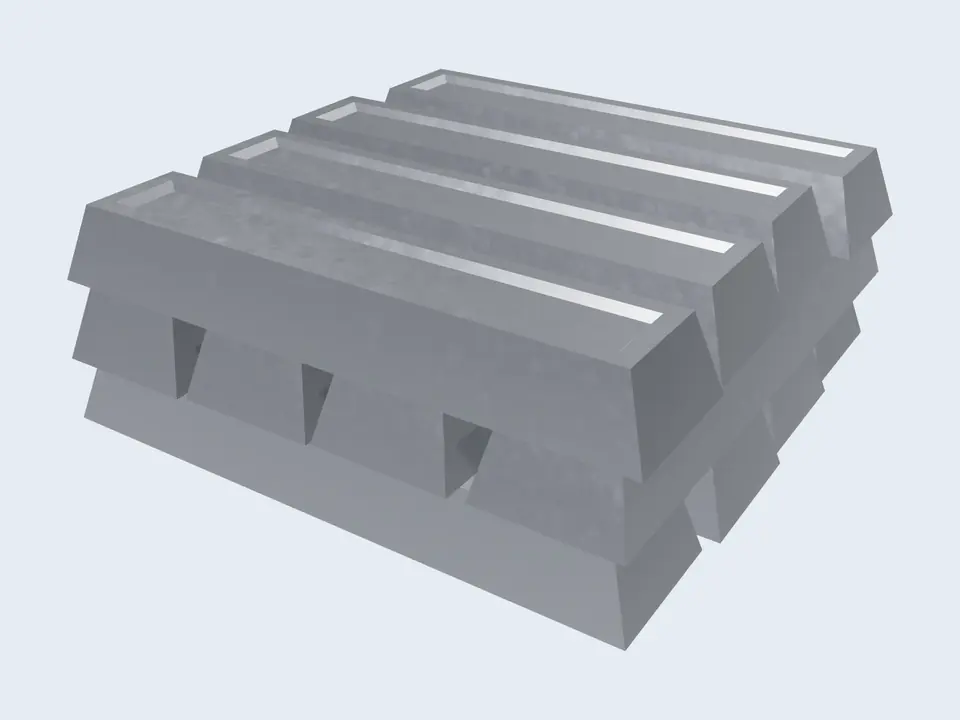
Lead ingots are cast blocks of refined lead, graded by minimum purity. IS 27:2023 covers primary lead from Pb99.90Cu up to Pb99.995, with Pb99.97 and Pb99.99 the most traded grades. They are used for batteries, radiation shielding, cable sheathing and lead alloys. Jubilant Impex supplies lead ingots in Bangalore with a test certificate.
Lead Ingots specifications
Typical values
| Density | 11.34 g/cm³ |
|---|---|
| Melting point | 327.5 °C |
| Boiling point | about 1749 °C |
| Atomic number | 82 |
Enquire about Lead Ingots
Tell us grade, size, quantity and delivery location. Every consignment ships with a test certificate.
Request a quoteWhatsApp +91 98441 25506Or call 080-41159995
How Lead Ingots measures up
View as table
| Metal | Density |
|---|---|
| Aluminium | 2.70 g/cm³ |
| Antimony | 6.68 g/cm³ |
| Zinc | 7.14 g/cm³ |
| Tin | 7.29 g/cm³ |
| Duplex 2205 | 7.80 g/cm³ |
| Carbon & mild steel | 7.85 g/cm³ |
| Stainless 304 | 7.93 g/cm³ |
| Incoloy 825 | 8.14 g/cm³ |
| Inconel 625 | 8.44 g/cm³ |
| Brass 70/30 | 8.53 g/cm³ |
| Gun metal | 8.72 g/cm³ |
| Monel 400 | 8.80 g/cm³ |
| Phosphor bronze | 8.86 g/cm³ |
| Hastelloy C276 | 8.89 g/cm³ |
| Nickel | 8.90 g/cm³ |
| Copper | 8.94 g/cm³ |
| Lead | 11.34 g/cm³ |
Lead is soft, heavy, cheap and melts at just 327 °C. That combination explains most of its uses. It fills moulds easily, it stops radiation and sound, it resists many acids, and it alloys readily with antimony and tin. It is also toxic, which is why buyers and handlers both need to know exactly what they are dealing with.
Lead ingots in Bangalore are bought mainly by battery workshops, solder and alloy makers, X-ray room fabricators and general foundries. This page covers the Indian purity grades, what each is used for, and the handling basics.
What are the IS 27 grades of lead?
IS 27 was revised in 2023 and retitled 'Primary Lead' instead of 'Pig Lead', since a pig is only one of the shapes lead is cast in. It now covers five grades: Pb99.90Cu, a chemical copper lead with a deliberate copper addition, then Pb99.97, Pb99.985, Pb99.99 and Pb99.995. The number is the minimum lead content in percent.
What separates the grades is the impurity allowance. Bismuth and silver are the elements that most often decide the grade, along with copper, and the table below compares the three grades buyers ask for most. For reference, Pb99.97 matches the London Metal Exchange's minimum of 99.970 percent, and Indian smelters also sell 99.99 material.
Which grade for which use?
Lead-acid battery makers are the largest users. Grey oxide for battery paste and pure lead parts need high-purity lead, because impurities such as bismuth, silver and copper affect gassing, self-discharge and plate life. Battery producers usually specify Pb99.97 or better, often Pb99.985 or Pb99.99, and many have their own tighter limits.
For radiation shielding, sheathing, ballast weights, counterweights and general castings, Pb99.97 is normally adequate. For alloying, the lead is the base to which antimony, tin or calcium is added. Hard lead for grids and castings uses antimony, and soft solders use tin; our tin-lead alloys page covers those.
| Element | Pb99.97 | Pb99.985 | Pb99.99 |
|---|---|---|---|
| Lead, min | 99.97 | 99.985 | 99.99 |
| Bismuth | 0.030 | 0.015 | 0.010 |
| Silver | 0.0050 | 0.0025 | 0.0015 |
| Copper | 0.0030 | 0.0010 | 0.0005 |
| Total impurities | 0.03 | 0.015 | 0.01 |
How much does a lead ingot weigh?
There is no single answer, as each producer casts its own mould. Primary lead ingots from large Indian smelters commonly weigh around 25 kg and are strapped into bundles of roughly one tonne. Smaller ingots are produced for workshops that melt in small pots. Tell us your melting pot size or handling limit and we will tell you what is available.
Ingots or sheet?
Ingots are for melting. If the job is lining an X-ray room, a tank, or a roof flashing, you want rolled lead sheet instead of casting your own. Lead sheets and other lead products are covered on the lead sheets page. Buying sheet saves a melting step and gives you a controlled thickness, which matters when shielding is specified in millimetres of lead.
Remelting your own scrap lead is another option some workshops use, but scrap rarely meets any IS 27 grade. Battery scrap in particular carries antimony and calcium from the grids. Fresh primary lead ingot with a certificate removes that guesswork.
Safe handling of lead ingots
Solid lead is safe to handle with gloves, but lead dust and fume are poisonous and build up in the body. Melting should be done with fume extraction, and workers should not eat, drink or smoke in the area. Wash hands before breaks. Keep ingots dry before charging into a pot, since water trapped under a cold ingot can cause molten lead to spit violently. Dross skimmed from the pot is hazardous waste and should be handled through an authorised recycler.
- Wear gloves and wash hands before eating.
- Melt only under local fume extraction.
- Preheat ingots to drive off moisture.
- Store away from food and from children's access.
Certificate and ordering
Tell us the grade, quantity and end use. Each lot can carry a test certificate from a Government-recognised test house, showing lead content and the impurity values against IS 27 limits. Jubilant Impex is ISO 9001:2015 certified, and the certificate is how you confirm the grade you paid for.
Where Lead Ingots is used
Questions about Lead Ingots
Still unsure? Call 080-41159995 or WhatsApp +91 98441 25506 and we will answer from the trade desk.
What is the purity of lead ingot?
Commercial primary lead ingots are usually 99.97 percent lead or higher. IS 27:2023 lists grades of Pb99.97, Pb99.985, Pb99.99 and Pb99.995, plus a copper-bearing Pb99.90Cu grade. The London Metal Exchange minimum is 99.970 percent, and many Indian smelters sell 99.99 percent lead for battery makers.
What is IS 27?
IS 27 is the Indian Standard for primary lead, formerly titled pig lead. The 2023 fifth revision covers five grades of lead ingot from Pb99.90Cu to Pb99.995 and sets the maximum limits for silver, bismuth, copper, antimony, tin, zinc and other impurities in each grade, along with sampling and marking requirements.
What is the melting point of lead?
Pure lead melts at 327.5 °C, which is low enough to melt in a simple pot over a gas burner. Lead alloys melt lower or over a range; for example, tin-lead solders start to melt below 200 °C. Lead fume rises sharply as temperature increases, so melting should be kept no hotter than needed and done under extraction.
Which grade of lead is used in batteries?
Lead-acid battery makers generally use high-purity primary lead, at least Pb99.97 and often Pb99.985 or Pb99.99, for making oxide and pure lead components. Elements such as bismuth, silver, copper and nickel affect gassing and self-discharge, so battery companies often add their own limits on top of the national standard.
What is the difference between pure lead and antimonial lead?
Pure lead is soft and very ductile. Antimonial lead, or hard lead, contains a few percent antimony, which makes it much harder and stronger, and lowers its melting point slightly. Antimonial lead is used for battery grids, cable fittings and castings that must hold their shape, while pure lead is used for oxide, sheet and shielding.
Keep exploring
Ingots
Jubilant Impex supplies lead, zinc and tin ingots and aluminium LM4 and LM6 alloy ingots from Bangalore.
View details →Lead Sheets & Products
Lead sheet is rolled lead, about 11.34 g/cm³ in density, soft enough to form by hand and resistant to sulphuric acid.
View details →Antimony
Antimony (Sb) is a brittle, silvery metalloid that melts at about 631 °C. Small additions harden lead for battery grids, cable…
View details →
Tin-Lead (Solder) Alloys
Tin-lead solder is an alloy of tin and lead that melts between 183 °C and about 260 °C depending on the ratio.
View details →Tin Ingots
Tin ingots are cast bars of refined tin, graded by minimum purity.
View details →
How to Read a Mill Test Certificate
To read a mill test certificate, first match the heat number on the certificate to the marking on the material.
View details →
Request a Quote
To request a quote for stainless steel pipes or any metal from Jubilant Impex in Bangalore, send the material, grade, standard,…
View details →Need Lead Ingots with a test certificate?
Send the material, grade, size and quantity. We confirm availability and price, with the test certificate details.