
- Home
- All Products
- Special Alloys & Non-Ferrous Metals
- Lead Sheets & Products
Lead Sheets for Shielding, Lining and Building
Lead sheet is rolled lead, about 11.34 g/cm³ in density, soft enough to form by hand and resistant to sulphuric acid. It is used for X-ray room shielding, acid tank and chamber lining, roof flashing, sound insulation and counterweights. Jubilant Impex in Bangalore supplies lead sheet with a test certificate from a Govt. recognised test house.
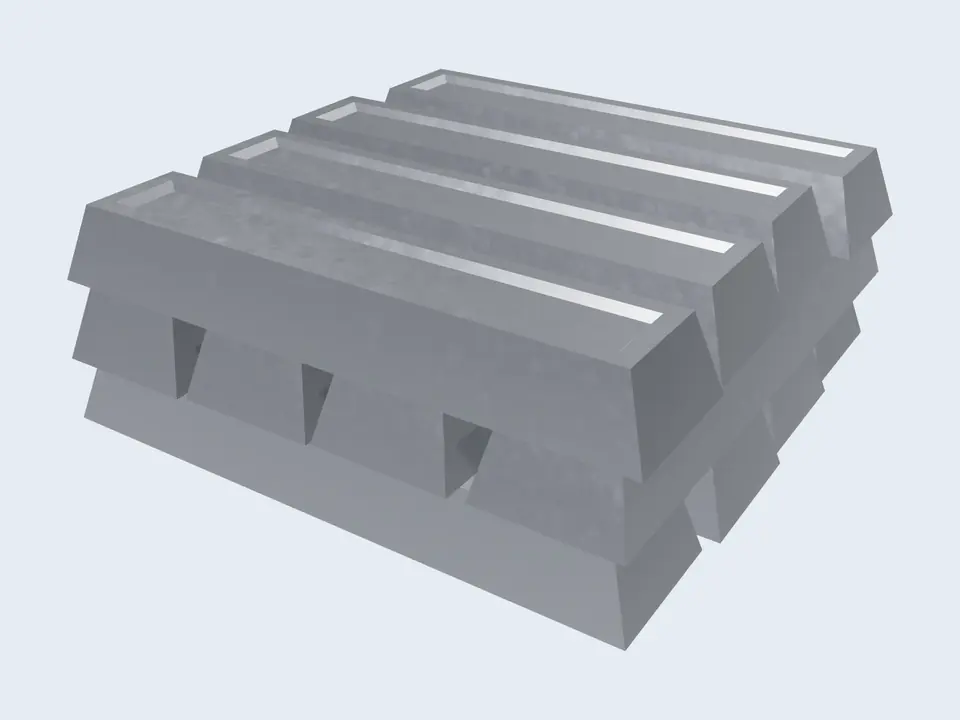
Lead Sheets & Products specifications
Typical values
| Density | 11.34 g/cm³ |
|---|---|
| Melting point | 327.5 °C |
| Weight per mm of thickness | about 11.34 kg/m² |
| Magnetic | No |
Designations in other standards
| Indian standard, chemical | IS 405 (Part 1) |
|---|---|
| Indian standard, general | IS 405 (Part 2) |
| Pig lead | IS 27 |
| Building lead sheet | BS EN 12588 |

Enquire about Lead Sheets & Products
Tell us grade, size, quantity and delivery location. Every consignment ships with a test certificate.
Request a quoteWhatsApp +91 98441 25506Or call 080-41159995
How Lead Sheets & Products measures up
View as table
| Metal | Density |
|---|---|
| Aluminium | 2.70 g/cm³ |
| Antimony | 6.68 g/cm³ |
| Zinc | 7.14 g/cm³ |
| Tin | 7.29 g/cm³ |
| Duplex 2205 | 7.80 g/cm³ |
| Carbon & mild steel | 7.85 g/cm³ |
| Stainless 304 | 7.93 g/cm³ |
| Incoloy 825 | 8.14 g/cm³ |
| Inconel 625 | 8.44 g/cm³ |
| Brass 70/30 | 8.53 g/cm³ |
| Gun metal | 8.72 g/cm³ |
| Monel 400 | 8.80 g/cm³ |
| Phosphor bronze | 8.86 g/cm³ |
| Hastelloy C276 | 8.89 g/cm³ |
| Nickel | 8.90 g/cm³ |
| Copper | 8.94 g/cm³ |
| Lead | 11.34 g/cm³ |
Lead is heavy, soft and not glamorous, and almost nothing else does its jobs as cheaply. A few millimetres stop diagnostic X-rays, a lead lining has protected sulphuric acid tanks for well over a century, and a lead flashing dressed by hand around a parapet will outlast the building.
Most of our lead sheet enquiries come from three directions: hospitals and diagnostic centres fitting out X-ray and CT rooms, chemical and plating units lining tanks, and contractors who need flashing or sound-deadening sheet. Each wants a different thickness and sometimes a different grade.
How thick should lead sheet be for an X-ray room?
There is no single number, and anyone who quotes one without seeing your layout is guessing. The required lead equivalence depends on the X-ray tube voltage, the workload, the distance to the wall and who sits on the other side: a corridor, an office or an empty yard. In India, diagnostic X-ray rooms must meet the requirements of the Atomic Energy Regulatory Board (AERB), and the shielding thickness for each wall, door and window comes from the approved room layout or a radiation physicist's calculation.
Once you have that thickness, we can supply plain lead sheet to suit. Doors are usually lined with sheet sandwiched in the door leaf, and walls either with sheet fixed behind board or with lead-lined panels. Joints must overlap; a butt joint in lead shielding leaks radiation.
Weight per square metre and lead codes
Lead weighs about 11.34 kg per square metre for every millimetre of thickness. A 2 mm sheet is roughly 22.7 kg/m², and a typical 1 m × 2 m sheet at that thickness is over 45 kg, which matters for handling, wall fixing and door hinges.
In building work, especially on British-style specifications, thickness is given as a code number under BS EN 12588. Code 3 is about 1.32 mm, Code 4 about 1.80 mm, Code 5 about 2.24 mm, rising to Code 8 at about 3.55 mm. The table further down lists the nominal weights. Indian chemical and general lead sheet is covered by IS 405, Part 1 for chemical purposes and Part 2 for other uses.
| Property | Soft lead sheet | Hard (antimonial) lead |
|---|---|---|
| Composition | Refined lead, low impurities | Lead with antimony, typically a few percent |
| Indian standard | IS 405 | IS 1654 |
| Stiffness and creep | Soft, creeps under its own weight | Stiffer, much better creep resistance |
| Forming | Easily bossed and dressed by hand | Harder to form |
| Typical use | Shielding, flashing, acid linings | Self-supporting parts, battery grids, castings |
Lead linings for acid tanks and chambers
Lead resists sulphuric acid because it forms an insoluble lead sulphate film that seals the surface. That is why lead has long been used to line sulphuric acid tanks, pickling vats, chromium plating tanks and acid drains. Joints in linings are made by lead burning, a fusion weld with a gas torch and a lead filler strip, not by soldering. It is skilled work, and a good lead burner is worth seeking out.
For chemical service, order sheet to IS 405 Part 1, which controls purity more tightly. Lead is not suitable for nitric acid, acetic acid or strong alkalis. For electroplating shops, our electroplating and finishing industry page covers the related anodes and metals.
Soft lead or hard lead?
Pure, or soft, lead creeps slowly under its own weight, so tall vertical linings and long unsupported spans can sag over the years. Adding antimony, typically a few percent, produces hard or antimonial lead, which is stiffer and stronger and is used for parts that must hold their shape. Lead-antimony alloys are covered in India by IS 1654. More on that alloying element is on our antimony page.
| Code | Thickness (mm) | Weight (kg/m²) |
|---|---|---|
| Code 3 | 1.32 | 15.0 |
| Code 4 | 1.80 | 20.4 |
| Code 5 | 2.24 | 25.4 |
| Code 6 | 2.65 | 30.1 |
| Code 7 | 3.15 | 35.7 |
| Code 8 | 3.55 | 40.3 |
Sound insulation and machine pads
Sound passes easily through light, stiff partitions. A thin layer of lead adds a lot of mass without stiffness, so it is used inside generator enclosures, studio and audiometry room walls, and around noisy pipework. Thin sheet of about 1 mm or less is common for this, often bonded to foam or board. Under heavy machines, lead or lead-faced pads help soak up vibration, though rubber and spring mounts have taken over much of that work.
Handling lead safely
- Wear gloves when handling sheet and wash hands before eating, drinking or smoking; most lead exposure at work is by swallowing dust from the hands.
- Cutting with snips or a knife makes no fume. Melting, lead burning and hot cutting do, so use extraction and respiratory protection.
- Do not use compressed air or dry sweeping to clean lead dust; vacuum or wet-wipe instead.
- Store and dispose of lead offcuts as scrap metal, not general waste. Scrap lead has good resale value.
Ordering lead sheet from Bangalore
Give us the thickness (or lead code, or kg/m²), sheet size or roll width, the quantity in square metres or kilograms, and whether it is for shielding, chemical or building use. Sizes are confirmed at enquiry. Lead sheet from us is backed by a test certificate through a Govt. recognised test house. If you are casting your own parts, see lead ingots instead.
Where Lead Sheets & Products is used
Questions about Lead Sheets & Products
Still unsure? Call 080-41159995 or WhatsApp +91 98441 25506 and we will answer from the trade desk.
What are lead codes?
Lead codes are a shorthand for rolled lead sheet thickness used in BS EN 12588 and British building practice. The code number is close to the old weight in pounds per square foot. Code 3 is about 1.32 mm and 15.0 kg/m², Code 4 about 1.80 mm, Code 5 about 2.24 mm, and so on up to Code 8 at about 3.55 mm and 40.3 kg/m².
How much does lead sheet weigh per square metre?
Multiply the thickness in millimetres by 11.34. A 1 mm sheet weighs about 11.3 kg/m², 2 mm about 22.7 kg/m², and 3 mm about 34 kg/m². This comes from lead's density of 11.34 g/cm³. For door and wall shielding, the weight decides the hinge, frame and fixing design, so work it out before ordering.
Is lead sheet safe to handle?
Lead sheet is safe to handle with basic precautions. Lead does not pass through intact skin in meaningful amounts; the risk is swallowing dust or residue from unwashed hands, or breathing fume when lead is melted or welded. Wear gloves, wash before eating, keep food away from the work area, and use extraction for lead burning or hot work.
Why is lead used to line acid tanks?
Lead reacts with sulphuric acid to form a thin layer of lead sulphate, which is insoluble in the acid and seals the metal from further attack. The lining is also easy to form into tanks and drains and is joined by lead burning. It is not suitable for nitric or acetic acid or strong alkalis, where the protective film does not form.
How do you cut lead sheet?
Thin lead sheet is cut with heavy-duty tin snips or a sharp utility knife: score a line along a straightedge, bend the sheet back and forth along the score, and it parts cleanly. Thicker sheet can be cut with a fine-tooth hand saw or a bandsaw. Avoid grinders and torches, which create lead dust and fume.
Keep exploring
Special Alloys & Non-Ferrous Metals
Special alloys are metals chosen when ordinary steel, stainless or brass will fail: nickel alloys such as Inconel, Incoloy, Monel…
View details →Lead Ingots
Lead ingots are cast blocks of refined lead, graded by minimum purity.
View details →Antimony
Antimony (Sb) is a brittle, silvery metalloid that melts at about 631 °C. Small additions harden lead for battery grids, cable…
View details →
Tin-Lead (Solder) Alloys
Tin-lead solder is an alloy of tin and lead that melts between 183 °C and about 260 °C depending on the ratio.
View details →
Electroplating & Surface Finishing
Electroplating materials are the metals a plating line consumes or conducts through: nickel anodes for nickel baths, lead-tin or…
View details →
Chemical & Process Plants
In chemical plants the metal is chosen by the fluid it handles.
View details →
Construction & Infrastructure
Construction projects use mild steel angles, channels, beams and plates to IS 2062 for structures, chequered plate for floors and…
View details →Need Lead Sheets & Products with a test certificate?
Send the material, grade, size and quantity. We confirm availability and price, with the test certificate details.