
- Home
- All Products
- Brass
- Brass 70/30 (Cartridge Brass)
70/30 cartridge brass for deep drawing, tubes and pressings
70/30 brass, also called cartridge brass (UNS C26000, EN CuZn30, BS CZ106), contains 68.5–71.5% copper with zinc as the balance. It is the most cold-ductile of the common brasses, so it is chosen for deep drawing, spinning and tube work. Jubilant Impex supplies it in Bangalore as sheet, strip and drawn tube.
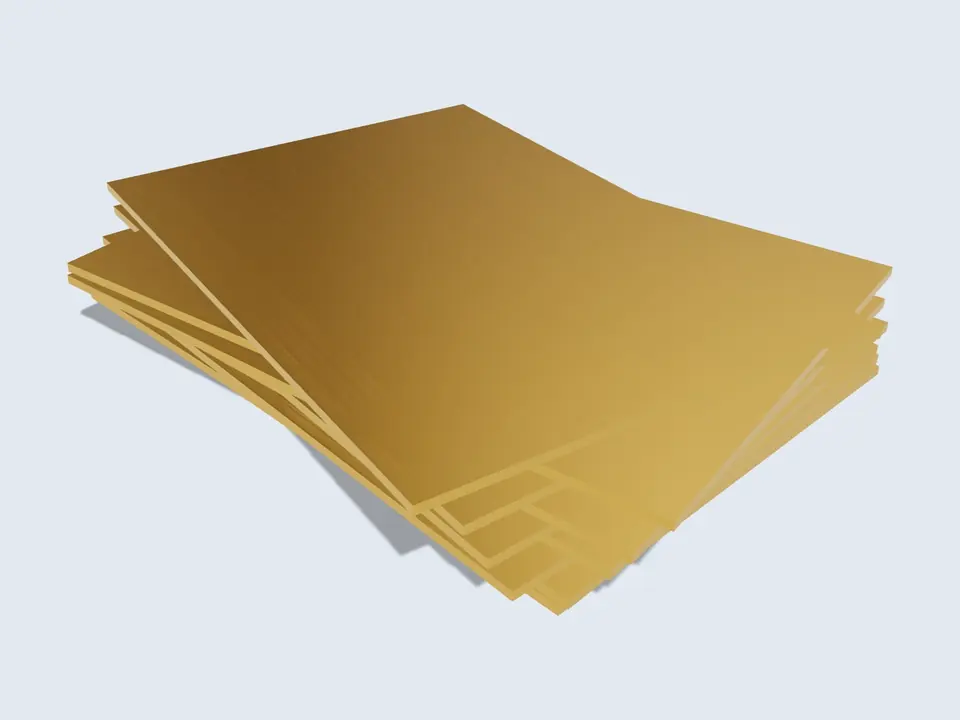
Brass 70/30 (Cartridge Brass) specifications
Per UNS C26000 (ASTM B36 / B927), weight %
| Cu | 68.5–71.5 |
|---|---|
| Pb | 0.07 max |
| Fe | 0.05 max |
| Zn | Remainder |
| Cu + named elements | 99.7 min |
EN 1652, CuZn30 sheet and strip, 0.2–5 mm
| R270 (annealed) | Rm 270–350 MPa, Rp0.2 160 MPa max |
|---|---|
| R350 | Rm 350–430 MPa, Rp0.2 170 MPa min |
| R410 | Rm 410–490 MPa, Rp0.2 260 MPa min |
| R480 (0.2–2 mm) | Rm 480 MPa min, Rp0.2 430 MPa min |
Typical values
| Density | 8.53 g/cm³ |
|---|---|
| Melting range | 916–954 °C |
| Electrical conductivity | 28% IACS |
| Thermal conductivity | 121 W/m·K at 20 °C |
| Modulus of elasticity | 110 GPa |
Designations in other standards
| UNS | C26000 |
|---|---|
| EN | CuZn30 / CW505L |
| BS | CZ106 |
| JIS | C2600 |
| IS | CuZn30 (IS 410) |
| Arsenical variant | C26130 / CuZn30As / CZ126 |
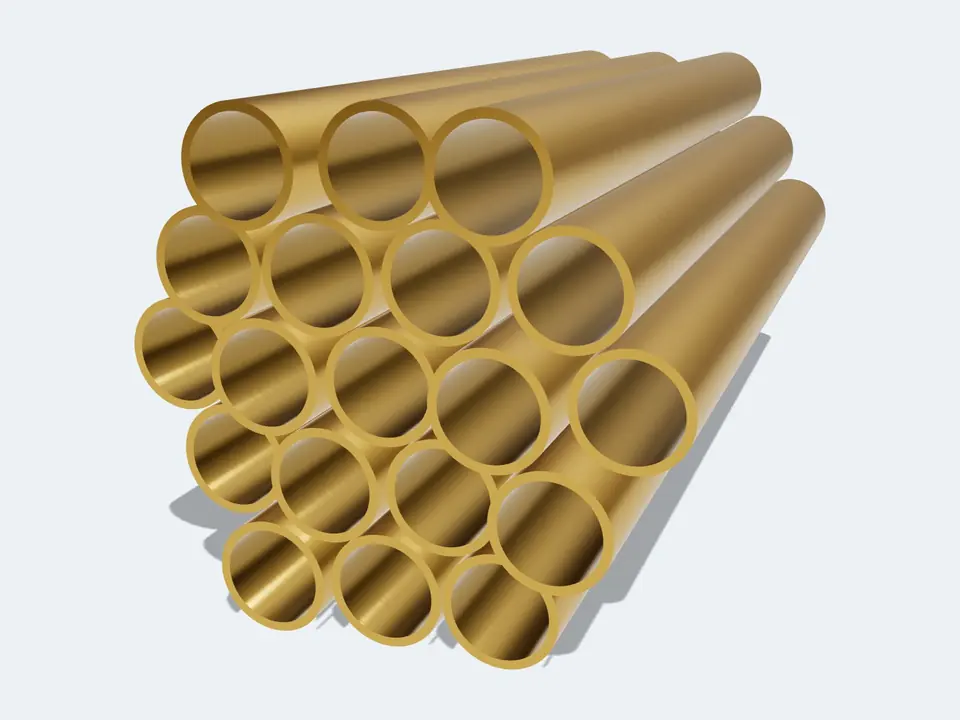
Available forms
Enquire about Brass 70/30 (Cartridge Brass)
Tell us grade, size, quantity and delivery location. Every consignment ships with a test certificate.
Request a quoteWhatsApp +91 98441 25506Or call 080-41159995
How Brass 70/30 (Cartridge Brass) measures up
- Zn 30%
- Cu 70%
View as table
| Element | Nominal % |
|---|---|
| Zn | 30% |
| Cu | 70% |
View as table
| Property | Specified |
|---|---|
| R270 | 270–350 MPa |
| R350 | 350–430 MPa |
| R410 | 410–490 MPa |
| R480 | 480 MPa min |
If a part has to be pulled into a deep cup without tearing, the drawing office will usually specify 70/30 brass. The extra copper keeps the metal in the single alpha phase, and alpha brass can be cold worked very heavily before it needs an anneal.
That ductility costs money, since copper is the expensive half of the alloy. So 70/30 tends to be used where the forming really demands it, and 63/37 or 60/40 takes over everywhere else.
Why is 70/30 called cartridge brass?
Because small-arms cartridge cases have been deep drawn from it for well over a century. A case is drawn from a flat cup in several stages, with anneals in between, and the brass has to stretch evenly through each stage without splitting at the mouth. Few other copper alloys at a similar price will take that much cold work. The name stuck, and today it covers the alloy whether it ends up in ammunition, a radiator tank or a lamp holder.
How much cold work will it take?
A lot, as long as you anneal between heavy reductions. In the annealed condition 70/30 can be drawn, spun, stretched and coined. As it is worked it hardens steadily, and the tensile strength roughly doubles from the soft to the fully hard condition. Once it reaches the hardness your process cannot handle, an intermediate anneal restores the ductility.
For deep drawing, grain size matters as much as tensile strength. Coarse grains leave an orange-peel surface on the drawn part, while very fine grains make the strip stiffer to form. EN 1652 deals with this by offering grain-size-controlled tempers alongside the tensile tempers, so a press shop can order to the finish it needs. For flat stock in this grade see our brass sheets and strips page.
| Element / item | C26000 (ASTM) | CuZn30 (EN) | C26130 arsenical |
|---|---|---|---|
| Cu % | 68.5–71.5 | 69.0–71.0 | 68.5–71.5 |
| Pb % max | 0.07 | 0.05 | 0.05 |
| As % | Not specified | Not specified | 0.02–0.08 |
| Main use | Sheet, strip, rod, drawn parts | Sheet, strip, deep drawing | Condenser and heat exchanger tube |
Reading the temper on an order
Three systems turn up on Indian drawings. IS 410 uses letter codes: O for annealed, then HA, HB, HD, HE and HS as the strip gets progressively harder, with HS the spring-hard end. ASTM uses H01 (quarter hard), H02 (half hard), H04 (hard) and so on up to the spring tempers. EN 1652 states the minimum tensile strength directly, so R350 means at least 350 N/mm².
These are not exact equivalents of each other. If a drawing quotes one system and your old supplier used another, send us both and we will match the tensile range rather than the label.
Arsenical 70/30 for heat exchanger tubes
Plain 70/30 can lose zinc in some waters, a form of corrosion called dezincification. Adding a small amount of arsenic, around 0.02 to 0.08 percent, largely stops it. That variant is UNS C26130, known in Britain as CZ126 and in Indian and European standards as CuZn30As. It is the 70/30 most often used in condensers, evaporators and the juice heaters covered on our sugar mill quality brass tube page.
Note that ASTM B111, the American condenser tube standard, does not list 70/30 at all. Arsenical 70/30 tubes are normally ordered to IS 1545, BS 2871 Part 3 or EN 12451.
Season cracking: the one weakness to plan for
Cold-worked 70/30 that still holds residual stress can crack if it meets ammonia or ammonium compounds, even in small amounts. The old name is season cracking, from cartridge cases that split in storage during the monsoon. Today it shows up in drawn parts stored near fertiliser, in cattle sheds, or in heat exchangers where ammonia is present in the process.
The fix is a low-temperature stress-relief anneal after forming, which removes most of the locked-in stress without softening the part much. If your parts will see ammonia, mention it at enquiry and we will talk about tempers before you order.
Where 70/30 sits against the other brasses
Compared with 63/37 brass, 70/30 is more ductile, a little more corrosion resistant and dearer. Compared with 60/40 it is far better cold and much worse hot, since it does not have the beta phase that makes Muntz metal forge so easily. It machines poorly, with a machinability rating of about 30 against 100 for free-cutting brass, so turned parts are rarely made from it.
Ordering 70/30 from us
Tell us the form, the standard you are buying to and the temper. For strip, give width, thickness and whether you need slit edges or mill edges. For tube, give OD, wall thickness or SWG, length and whether the ends must be annealed for expanding into a tube plate. If the part is deep drawn, mention the draw depth and blank diameter so we can check the temper with you before cutting.
Each lot is supplied with a test certificate from a Government-recognised test house showing copper, lead and iron against the standard, which is the quickest way to confirm you have genuine 70/30 and not a lower-copper brass sold under the same name.
Where Brass 70/30 (Cartridge Brass) is used
Questions about Brass 70/30 (Cartridge Brass)
Still unsure? Call 080-41159995 or WhatsApp +91 98441 25506 and we will answer from the trade desk.
Is 70/30 brass good for deep drawing?
Yes. It is the standard brass for deep drawing because its single alpha-phase structure lets it stretch heavily when cold. Buy it annealed, or in a grain-size-controlled temper if surface finish matters, and plan intermediate anneals for multi-stage draws. Stress relieve the finished parts if they will see ammonia.
Is C26000 the same as CZ106?
They describe the same 70/30 cartridge brass under different systems: C26000 is the American UNS number and CZ106 is the older British Standard designation. The European equivalent is CuZn30 (CW505L). Composition limits differ slightly between standards, so check the one named on your drawing.
What is the density of 70/30 brass?
The density of 70/30 cartridge brass is 8.53 g/cm³, or 8,530 kg/m³. For quick weight estimates, a 1 mm thick sheet weighs about 8.5 kg per square metre, and a round rod weighs about 0.0067 × d² kg per metre, with d in millimetres.
What is the melting point of cartridge brass?
Cartridge brass melts over a range rather than at a single temperature. It starts to melt at about 916 °C (solidus) and is fully liquid at about 954 °C (liquidus). Higher-zinc brasses such as 60/40 melt a little lower, around 900 °C.
Can 70/30 brass be brazed and soldered?
Yes. It solders easily with ordinary tin-based solders and brazes well with silver brazing alloys. Gas welding is possible but zinc fumes off at welding heat, so the joint area loses zinc and becomes porous. For pressure work, brazing is usually preferred over fusion welding.
Why does cold-worked brass crack in storage?
This is season cracking, a form of stress corrosion cracking. Residual stress from cold work combined with traces of ammonia or moisture in the air causes intergranular cracks, often weeks after forming. A low-temperature stress-relief anneal after forming prevents it in most cases.
Keep exploring
Brass
Jubilant Impex in Bangalore supplies brass in the three common copper–zinc ratios (70/30, 63/37 and 60/40) as round, hex and…
View details →Brass 63/37 (Yellow Brass)
63/37 brass is a yellow brass with about 63% copper and 37% zinc, covered by UNS C27200 and C27400, EN CuZn37 (CW508L) and BS…
View details →Brass 60/40 (Muntz Metal)
60/40 brass, or Muntz metal (UNS C28000, EN CuZn40, BS CZ109), contains 59.0–63.0% copper with zinc as the balance.
View details →Brass Sheets, Plates, Flats & Strips
Jubilant Impex supplies brass sheet in Bangalore along with plates, flats and strips in 70/30, 63/37 and 60/40 grades.
View details →Brass Pipes, Tubes & Capillary
Jubilant Impex supplies brass pipe and tube in Bangalore, drawn in 70/30, 63/37 and 60/40 brass, along with small-bore brass…
View details →Sugar Mill Quality Brass Pipes
In Indian sugar mills, "sugar mill quality" brass tube usually means seamless 70/30 arsenical brass (CuZn30As, BS CZ126, UNS…
View details →Brass 70/30 vs 63/37 vs 60/40
70/30, 63/37 and 60/40 brass are copper-zinc alloys named by their approximate copper-to-zinc ratio.
View details →Need Brass 70/30 (Cartridge Brass) with a test certificate?
Send the material, grade, size and quantity. We confirm availability and price, with the test certificate details.