
- Home
- All Products
- Brass
- Brass 63/37 (Yellow Brass)
63/37 yellow brass: the economical choice for pressings and tube
63/37 brass is a yellow brass with about 63% copper and 37% zinc, covered by UNS C27200 and C27400, EN CuZn37 (CW508L) and BS CZ108. It cold forms well enough for blanking, bending and moderate drawing at lower cost than 70/30. Jubilant Impex in Bangalore supplies it as sheet, strip, tube and rod.
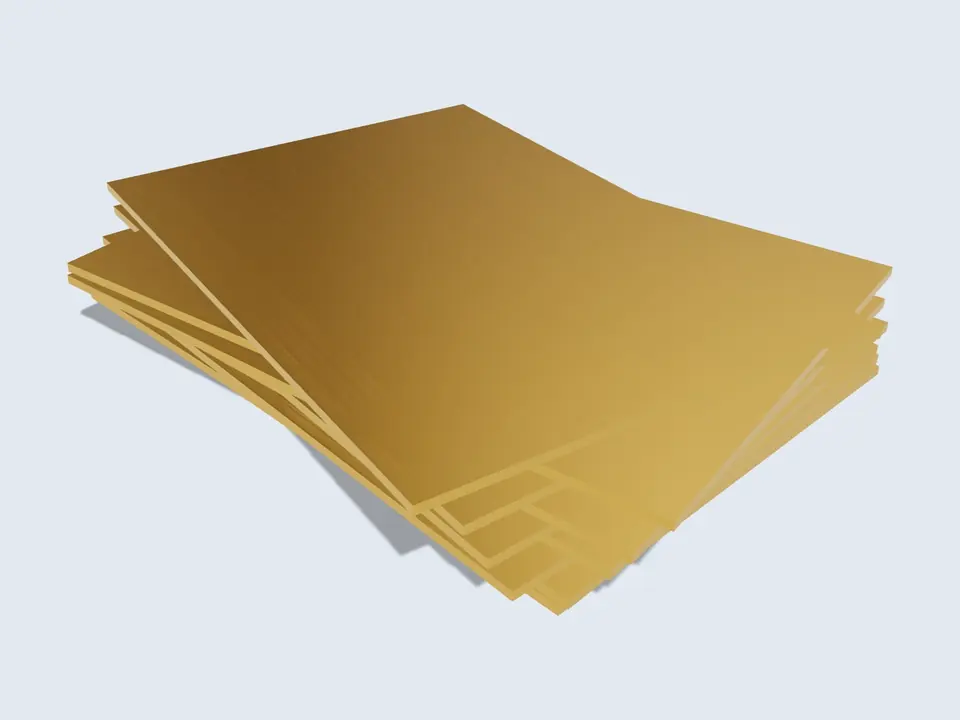
Brass 63/37 (Yellow Brass) specifications
Per UNS C27200 (ASTM B36 / B135), weight %
| Cu | 62.0–65.0 |
|---|---|
| Pb | 0.07 max |
| Fe | 0.07 max |
| Zn | Remainder |
| Cu + named elements | 99.7 min |
EN 1652, CuZn37 sheet and strip
| R300 (annealed, 0.2–5 mm) | Rm 300–370 MPa, Rp0.2 180 MPa max |
|---|---|
| R350 (0.2–5 mm) | Rm 350–440 MPa, Rp0.2 170 MPa min |
| R410 (0.2–5 mm) | Rm 410–490 MPa, Rp0.2 300 MPa min |
| R480 (0.2–2 mm) | Rm 480–560 MPa, Rp0.2 430 MPa min |
| R550 (0.2–2 mm) | Rm 550 MPa min, Rp0.2 500 MPa min |
Designations in other standards
| UNS | C27200 / C27400 |
|---|---|
| EN | CuZn37 / CW508L |
| BS | CZ108 |
| JIS | C2720 |
| IS | CuZn37 (IS 410) |

Available forms
Enquire about Brass 63/37 (Yellow Brass)
Tell us grade, size, quantity and delivery location. Every consignment ships with a test certificate.
Request a quoteWhatsApp +91 98441 25506Or call 080-41159995
How Brass 63/37 (Yellow Brass) measures up
- Zn 36%
- Cu 64%
View as table
| Element | Nominal % |
|---|---|
| Zn | 36% |
| Cu | 64% |
View as table
| Property | Specified |
|---|---|
| R300 | 300–370 MPa |
| R350 | 350–440 MPa |
| R410 | 410–490 MPa |
| R480 | 480–560 MPa |
| R550 | 550 MPa min |
Ask a press shop which brass they actually run through their machines day to day and the answer is often 63/37. It bends, blanks and draws to a moderate depth, it takes a good polish, and it uses about seven percent less copper than 70/30.
The catch is that the name is used loosely. Three different specifications can arrive on a purchase order as 63/37, and they are not quite the same metal.
63/37, 65/35 or yellow brass: sorting out the names
In the American system, yellow brass is a family rather than one alloy. C27000 runs from 63.0 to 68.5 percent copper, C27200 from 62.0 to 65.0 percent and C27400 from 61.0 to 64.0 percent. In the European system, CuZn37 sits at 62.0 to 64.0 percent copper. All of them get called 63/37 in the market, and older catalogues may still call C27000 by its 65/35 nickname.
For most pressed and bent parts the difference does not matter. Where it does matter is deep drawing: the lower the copper, the closer the alloy gets to the two-phase region and the sooner it work-hardens. If your drawing names a specific UNS or EN grade, quote that exact designation when you send an enquiry.
Where 63/37 earns its place
It is the general-purpose cold-working brass. Typical jobs include blanked and bent electrical parts, lamp and lighting fittings, rivets, eyelets, decorative trim, radiator cores, name plates and the large volume of sheet work done in small fabrication units. It also goes into drawn tube for general engineering, instrument lines and furniture, and many brass pipes and tubes sold for non-pressure work are 63/37.
It solders and brazes easily, buffs to a bright yellow finish and plates well, which is why so many hardware and fittings makers in South India use it for visible parts.
| Grade | Cu % | Pb % max | Fe % max |
|---|---|---|---|
| C27000 (ASTM) | 63.0–68.5 | 0.09 | 0.07 |
| C27200 (ASTM) | 62.0–65.0 | 0.07 | 0.07 |
| C27400 (ASTM) | 61.0–64.0 | 0.09 | 0.05 |
| CuZn37 / CW508L (EN) | 62.0–64.0 | 0.10 | 0.10 |
What do you give up compared with 70/30?
Some ductility and a little corrosion resistance. 70/30 cartridge brass will go through more draw stages before it needs annealing, and it is less prone to dezincification. For a shallow cup, a bracket or a bent strip, 63/37 is plenty. For a deep shell, a thin-walled spun part or a tube that will sit in hot water service for years, the extra copper in 70/30 is usually worth paying for.
Like 70/30, cold-worked 63/37 can season crack if residual stress meets ammonia. A stress-relief anneal after forming takes care of most of that risk.
Choosing a temper for bending and blanking
Tempers control how a strip behaves in the tool. Annealed material (R300) bends flat on itself and draws well but scratches and dents in handling. Half-hard (around R350 to R410) is the common choice for blanked and lightly formed parts because it holds shape and still bends to a tight radius across the rolling direction. Hard and spring tempers (R480, R550) are for parts that must stay flat or act as a spring, such as contacts and clips.
Under IS 410 the same ladder runs O, HA, HB, HD, HE and HS. If you are bending sharply, tell us the bend radius and the strip thickness and we will suggest a temper that will not crack on the outside of the bend. For the hardest end of the range see spring quality brass.
Can you machine 63/37?
You can, but it is not pleasant. Without lead the chips come off long and stringy and wrap around the tool, and surface finish suffers at high speed. Its machinability is rated at about 30 percent of free-cutting brass. For anything that will be turned, drilled and threaded in volume, order leaded free-cutting rod instead and keep 63/37 for the sheet, strip and tube work it is suited to.
Details to send with a 63/37 enquiry
Most delays on brass orders come from a missing detail, so it helps to send everything in the first message. For sheet and strip we need the thickness in millimetres or SWG, the width, the sheet size or coil weight, and the temper. For tube we need OD, wall, length and temper. Mention the specification if the drawing names one, for example C27200 to ASTM B36 or CuZn37 to EN 1652.
We supply 63/37 brass with a test certificate from a Government-recognised test house, and the certificate lists the copper, lead and iron values so your quality team can check them against the grade. If you are switching from 70/30 to save cost, send a sample part or drawing first and we can tell you honestly whether 63/37 is likely to form it without splitting.
Where Brass 63/37 (Yellow Brass) is used
Questions about Brass 63/37 (Yellow Brass)
Still unsure? Call 080-41159995 or WhatsApp +91 98441 25506 and we will answer from the trade desk.
What is 63/37 brass?
63/37 brass is a copper–zinc alloy with about 63% copper and 37% zinc, often called yellow brass. It is designated C27200 or C27400 in the UNS system, CuZn37 (CW508L) in Europe and CZ108 in older British standards. It is used for sheet, strip and tube that is cold formed.
Is yellow brass the same as 63/37?
Mostly. Yellow brass is a family name covering C27000, C27200 and C27400, with copper ranging from about 61% to 68.5% depending on the grade. The 63/37 ratio sits in the middle of that family. If your application is sensitive, specify the exact UNS or EN grade rather than the common name.
What is CZ108 brass?
CZ108 is the old British Standard designation for 63/37 brass, roughly 63% copper and 37% zinc. Under the current European system it is CuZn37 or CW508L. It is a cold-working brass used for presswork, deep-drawn parts of moderate depth, and general engineering tube and sheet.
Is 63/37 brass lead free?
Practically, yes. Lead is treated as an impurity in 63/37 and is limited to 0.07% to 0.10% maximum depending on the specification. That is why it is not used for high-speed turning. Leaded free-cutting brass, by contrast, contains 2.5% to 3.5% lead added deliberately.
Is 63/37 brass cheaper than 70/30?
Usually, yes. Copper costs considerably more than zinc, and 63/37 contains about seven percentage points less copper than 70/30, so it is normally priced lower per kilo. The saving is why it is chosen for parts that do not need the extra ductility or corrosion resistance of 70/30.
Does 63/37 brass tarnish?
Yes. Like all brass it forms a dull oxide film in air, faster in humid or polluted conditions. Polishing removes it, and a clear lacquer, a passivating dip or nickel or chrome plating keeps a bright surface for longer on decorative parts.
Keep exploring
Brass
Jubilant Impex in Bangalore supplies brass in the three common copper–zinc ratios (70/30, 63/37 and 60/40) as round, hex and…
View details →Brass 70/30 (Cartridge Brass)
70/30 brass, also called cartridge brass (UNS C26000, EN CuZn30, BS CZ106), contains 68.5–71.5% copper with zinc as the balance.
View details →Brass 60/40 (Muntz Metal)
60/40 brass, or Muntz metal (UNS C28000, EN CuZn40, BS CZ109), contains 59.0–63.0% copper with zinc as the balance.
View details →Brass Sheets, Plates, Flats & Strips
Jubilant Impex supplies brass sheet in Bangalore along with plates, flats and strips in 70/30, 63/37 and 60/40 grades.
View details →Spring Quality Brass
Spring brass strip is 70/30 or 63/37 brass cold rolled to its hardest tempers, such as HS under IS 410, R550 under EN 1652 or H08…
View details →Brass 70/30 vs 63/37 vs 60/40
70/30, 63/37 and 60/40 brass are copper-zinc alloys named by their approximate copper-to-zinc ratio.
View details →
Electrical & Power Distribution
Electrical and power distribution equipment runs on EC grade copper, which is at least 99.9% pure with conductivity close to 100%…
View details →Need Brass 63/37 (Yellow Brass) with a test certificate?
Send the material, grade, size and quantity. We confirm availability and price, with the test certificate details.